vineri, 2 februarie 2024

The Problem "S:L23.322" and probably its neighbors


    It is page 9 of the "SUPLIMENTUL cu EXERCIȚII al GMB N0 12/2023".
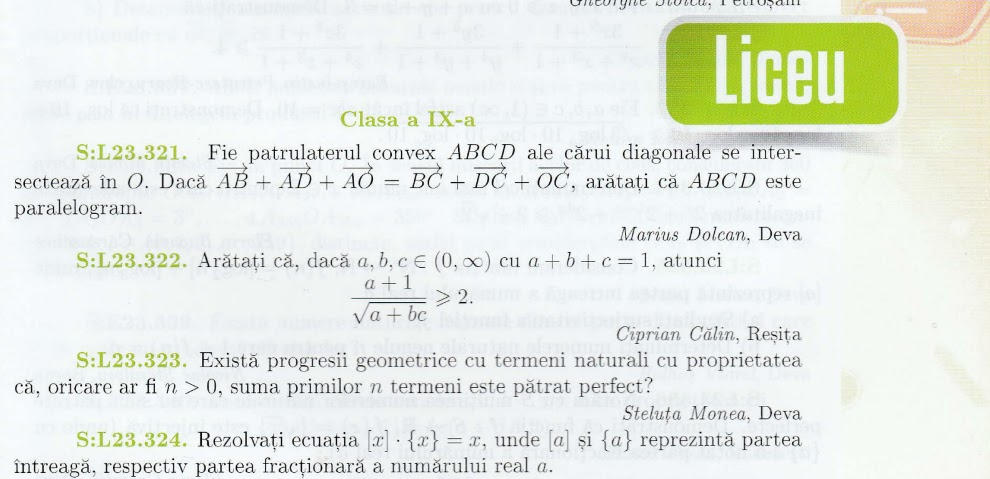

          In translation
               "S:L23.322.    Show that if  $\;a,\;b,\;c\in (0,\;\infty)$  and  $a+b+c=1$, then

$$\frac{a+1}{\sqrt{a+bc}}\geqslant 2."$$

           Solution CiP 

           We have the known inequality 

$\frac{x+y}{\sqrt{xy}}\geqslant 2 \tag{1}$

where $x,\;y$ are positive real numbers. The sign $"="$ occurs in (1) if and only if $x=y.$

(The deduction of (1) is immediate from the equivalents

$$(\sqrt{x}-\sqrt{y})^2 \geqslant 0\;\Leftrightarrow\;x-2\sqrt{x}\cdot \sqrt{y}+y \geqslant 0\;\Leftrightarrow\;x+y\geqslant 2\sqrt{xy}\;\Leftrightarrow\;(1)\;)$$

          Back to the problem, it results from the given conditions that $\;a,b,c<1$ (because, for example $a=1-b-c<1-0-0$ and $-b,-c<0$).

Then the numbers  $x=1-b$  and  $y=1-c$  are positive. But we have
$$a+1=1-b-c+1=(1-b)+(1-c)=x+y$$

and

$$a+bc=1-b-c+bc=(1-b)(1-c)=xy$$

and then the inequality (1) expresses exactly what the statement requires.

$\blacksquare$

          Remark CiP  The statement does not ask when the $"="$ sign occurs. We will answer, as a bonus.

The sign $"="$ occurs if and only if $(a,b,c)=(1-2t,t,t)$ with  $t\in (0, \frac{1}{2}).$ 

Even the values $t=0$ (when $a=1,\;b=c=0$) and $t=\frac{1}{2}$ (when $a=0,\;b=c=\frac{1}{2}$) are admissible for the statement.

<end Rem>


..................................................................................................................................

          As Mr. Konstantine ZELATOR used to us, a problem never appears alone. I am referring to his  posts related to problems in the Crux Mathematicorum magazine (although he also has concerns about UFO-logy). As I announced in the title, we will also try to solve the other problems on the photographed page.


              " S:L23.321.  Let $ABCD$ be the convex quadrilateral whose diagonals 

          intersect at $O$. If $\overrightarrow{AB}+\overrightarrow{AD}+\overrightarrow{AO}=\overrightarrow{BC}+\overrightarrow{DC}+\overrightarrow{OC}$, show that $ABCD$

          is a parallelogram."

                  Solution CiP

          It seems that no figure would be needed.

I did one, with a trembling hand.

          The relationship given between the six vectors is written, replacing some of them with the sum of two others, in the form

$(\overrightarrow{AO}+\overrightarrow{OB})+(\overrightarrow{AO}+\overrightarrow{OD})+\overrightarrow{AO}=(\overrightarrow{BO}+\overrightarrow{OC})+(\overrightarrow{DO}+\overrightarrow{OC})+\overrightarrow{OC}\;\Leftrightarrow$

$\Leftrightarrow\;3\overrightarrow{AO}+\overrightarrow{OB}+\overrightarrow{OD}=\overrightarrow{BO}+3\overrightarrow{OC}+\overrightarrow{DO}\;\Leftrightarrow$

$\Leftrightarrow \;3(\overrightarrow{AO}-\overrightarrow{OC})=2\overrightarrow{BO}+2\overrightarrow{DO}\;\Leftrightarrow\;$

$\Leftrightarrow\;3(\overrightarrow{AO}+\overrightarrow{CO})=2(\overrightarrow{BO}+\overrightarrow{DO}).\;\tag{1}$

     On the left side of the relation (1) we have a sum of two vectors  collinear with $\overrightarrow{AC}$, so the result will also be a vector collinear with $\overrightarrow{AC}$. On the right side of the relation (1) we have a sum of two  vectors collinear with $\overrightarrow{BD}$, so the result will also be a vector collinear with $\overrightarrow{BD}$. Thus, equality (1) is possible only if

$$\overrightarrow{AO}+\overrightarrow{CO}=\overrightarrow{0}=\overrightarrow{BO}+\overrightarrow{DO}\;\Leftrightarrow$$

$\Leftrightarrow\;\overrightarrow{AO}=-\overrightarrow{CO}=\overrightarrow{OC}$ and $\overrightarrow{BO}=-\overrightarrow{DO}=\overrightarrow{OD}.$ But this means that point $O$ is both the midpoint of segment $[AC]$ and the midpoint of $[BD]$, thus $ABCD$ is a parallelogram.

$\blacksquare$


joi, 1 februarie 2024

sâmbătă, 27 ianuarie 2024

MAXIMA and MINIMA Without CALCULUS


          I saw, flipping through a list of problems for the Mathematics Olympiad for Juniors, the following question:

"If   $0<x<1$   prove that   $x-x^3\;<\frac{1}{2}$."

           I would be curious what the simplest solution would be. I had another post like this here. And I mean a solution that does not call for advanced mathematical knowledge, for example Calculus.


          Anyone with even a little Calculus experience realizes that the statement of the problem hides an insufficiency: does the expression $x-x^3$ have a maximum or a minimum on the interval $0<x<1$ ?; and what are the values of  $x$ that achieve them ?

     Following this line, Calculus teaches us to find out the largest and smallest value taken by the function

$$f\;:\;[0;1]\rightarrow \mathbb{R},\;\;f(x)=x-x^3$$

(or the extension of this function to the entire real axis $-\infty <x<+\infty$).

     The derivative ${f}'=1-3x^2$ has critical (stationary) points $x_\pm=\pm \frac{1}{\sqrt{3}}$.


As can be seen from the Variation Table of the Function, at $x_-$ we have a local minimum, and at $x_+$ - a local maximum. The conclusion of this study is that

If $0<x<1$ then $x-x^3 \leqslant \frac{2}{3\sqrt{3}}. \;\;\;\;\;(1)$ 

Equality occur at $x_+=\frac{1}{\sqrt{3}}$.

Remark CiP  Before I had time to complete the Variation Table of the function, Mr. George Stoica already posted his comment with an elementary solution to both the initial version (obtaining a slight strengthening) and a solution to the "optimal" version (1).

<end Rem>


          The title of the post is inspired by the similar title of a book, we could call it famous, by Ivan NIVEN, (The MATHEMATICAL ASSOCIATION of AMERICA, 1981). Even after decades, this book is still quoted with interest; see Berkeley Math Circle : Tom Rike, Maxima and Minima Problems WITHOUT Calculus, 2002

          We will give a demonstration based on the maximum product principle. It is stated as follows

          If the sum of $n$ non-negative real numbers is constant, then their

          product is maximum when the numbers are equal.

          Let be the product of three factors $P=x\cdot (1-x) \cdot (1+x).$

The sum of the three factors is $x+(1-x)+(1+x)=2+x$. Unfortunately, it is not constant, so we will resort to a "trick". We consider the product

$$P_1=(\sqrt{3}+1)(2+\sqrt{3}) \cdot P=$$

$$=[(\sqrt{3}+1)x]\cdot [(2+\sqrt{3})(1-x)] \cdot [1+x].$$

The sum of the three factors is now 

$[x\sqrt{3}+x]+[2+\sqrt{3}-2x-x\sqrt{3}]+[1+x]=3+\sqrt{3}$

 and is now a constant. So the maximum of $P_1$ occurs when

$$(\sqrt{3}+1)x=(2+\sqrt{3})(1-x)=1+x.$$

But the three conditions above are satisfied exactly when $x=\frac{1}{\sqrt{3}}.$

Now, $P_1$ and $P$ differ by a positive factor, so they are maximum at the same time.

$\blacksquare$

       Things don't end there. Some might say that this solution is like pulling a rabbit out of a hat. I applied a method known in the French mathematical literature as belonging to M. Grillet. Unfortunately, in the "Éléments d'algèbre, à l'usage des candidats au baccalauréat ès sciences et aux écoles spéciales" par Eugène Rouché (Paris, MALLET-BACHELIER , IMPRIMEUR-LIBRAIRE, 1857) on page 181, only the Nouvelles Annales are mentioned, without any other specification.

        We start by finding three numbers  $\alpha,\;\beta,\;\gamma\;$ so that the product

$$P_1=\alpha \cdot \beta \cdot \gamma \cdot P=[\alpha \cdot x]\cdot [\beta \dot (1-x)] \cdot [\gamma \cdot (1+x)]$$

 has a constant sum of factorsThe sum of these factors is

$$(\alpha x)+(\beta-\beta x)+(\gamma +\gamma x)=(\alpha -\beta+\gamma)\cdot x+(\beta+\gamma).$$

If we choose $\alpha -\beta +\gamma =0$, then $\alpha = \beta-\gamma$ and

$$P_1=[(\beta-\gamma)x]\cdot [\beta(1-x)]\cdot [\gamma(1+x)]$$

has a constant sum of factors. $P_1$ is maximum for

$$(\beta-\gamma) \cdot x =\beta-\beta\cdot x=\gamma+\gamma \cdot x .\tag{2}$$

From the first equality we get $x=\frac{\beta}{2\beta-\gamma}$ and from the second equality we get $x=\frac{\beta-\gamma}{\beta+\gamma}.$ In order for relations (2) to be compatible, we must have

$$\frac{\beta-\gamma}{\beta+\gamma}=\frac{\beta}{2\beta-\gamma}\;\Leftrightarrow\;\beta^2-4\beta \gamma+\gamma^2=0.$$

We choose $\frac{\beta}{\gamma}>1$ to have $\beta-\gamma >0$, so $\frac{\beta}{\gamma}=2+\sqrt{3}.$ In our trick we took $\gamma=1,\;\beta=2+\sqrt{3},\;\alpha=1+\sqrt{3}.$

(Remark. In the case of more than three variables, conditions like those in (2) lead to equations of degree higher than 2, so they are more difficult to handle.)


!! Finally, I found exactly. Grillet, H. Méthode élémentaire pour résoudre quelques questions sur les maximums. Nouvelles annales de mathématiques : journal des candidats aux écoles polytechnique et normale, Serie 1, Volume 9 (1850), pp. 70-73.